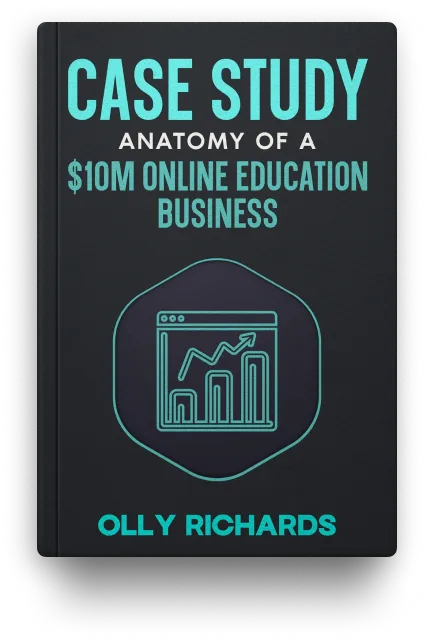
For an education business, a book is one of the most powerful lead-generation assets you can build. Someone who spends real time with your ideas at that depth gets to know you and forms a strong relationship with you, and that makes them more likely to buy from you later.
But you can’t assume everyone who buys the book will read it. Some people never get round to it. If they don’t, all that time and effort you put into creating the book may not turn into the customer relationship you were hoping for. So the job is not just getting the sale. It’s giving people shorter, easier ways to consume the same ideas and get value sooner.
The Bottleneck Is Consumption, Not the Sale
If you think everyone who buys your book sits down and dutifully reads it, I’m afraid you’re in for a bit of a letdown. Some will read it within a week. Some in a year. Some never. I suspect the last group is the biggest, because if you’re anything like me, you collect books and only ever get round to reading a handful of them.
I started a business book called Anatomy of a $10 Million Online Education Business as a Google doc, self-published it on Amazon, and later ran it as an ads funnel that did very well. On the back end, I made multiple seven figures from people who read it and then contacted me for business mentorship.
But I was also aware that for every person who converted that way, there were many more ideal clients who never contacted me. The reason was usually simple: they never got through the book.
Anchor Every Format to One Named Mechanism
Before you build anything, answer one question: what exactly are you forcing people to consume?
In my language business, StoryLearning, the underlying mechanism is the StoryLearning method. It teaches languages through stories. If someone sees my social media, watches my YouTube content, reads one of my language books, takes a course, or buys me a Negroni and asks how to learn a language, the thing they get is the same. It’s just presented in different ways.
The same should be true of your book. The book presents the same underlying method in another format, just as a social media post, a course, or a face-to-face conversation does.
Some people will follow you on social media. Some people will want to talk to you face to face. Some people will read your book. What they get is the same; it’s simply presented in different ways.
That matters because every lower-effort format later on only works if it carries the same mechanism in a smaller form. Ideally the method is named, like StoryLearning, so people can recognise it. The real requirement is that the way you get results stays the same.
Offer the Book in Easier-to-Consume Formats
Start with the obvious. An audiobook catches the person who won’t read but will listen in the gym or on a walk.
You can also record yourself reading the book on video and post it to YouTube. A lot of my author friends do this. They post an eight-hour video. It sounds crazy, but it gets loads of views because some people consume long content that way. It’s another way of getting the same content consumed.
Those are still the full-length book. The barrier to consuming it is still quite high. So what happens if you break that down a little bit more?
With my business book, I took the five main lessons and recorded five short videos. Each one taught a single lesson from the book. I sent them out by email, ran retargeting ads so the next time someone opened Instagram they’d see them, and put them all on a web page with a widget so people could binge the lot.
After buying the book, the buyer gets presented with small snippets that are a way in. They might watch one video, like it, and return to the book they already own. You want the existing buyer to consume something.
Give Buyers a Result in Five Minutes
Take the underlying mechanism and create an interactive quiz using AI. I could create one based on the business-model chapter in my book. Someone inputs information about their business, and the quiz helps them think through their optimal business model. It’s short and contained, and value can arrive in perhaps five minutes.
Once someone gets value from that, the next logical step is often to go back to the book, because the quiz was really good.
You could also build a custom GPT on the same method. I’m not sure whether standalone GPTs are still available in that form, but the question is the same: can you create a tool that gets people a specific result quickly? Let’s imagine that in my book I’m talking about how I create content ideas. The tool would let someone put in their expertise and get content ideas back using that method. That was a random example off the top of my head.
What you’re trying to do here is compress time to result. If someone never reads the book, or is going to take three months to read it, this custom GPT can get them a result of some kind within five minutes. When you speed up time to value, you’re now advancing them along the customer journey. They are much more likely to want to engage with you and buy.
Use a Live Workshop to Convert the Non-Reader
Then there’s the person who won’t read, won’t listen, and won’t use a tool. They’ll show up live.
In high-ticket businesses, I’ve been helping people replace the endless monthly promotion of a high-ticket offer with a free or paid live workshop. People join you for 30 or 40 minutes, learn a very specific thing, and spend some time with you live. Then there is an offer that can be made at the end to join the high-ticket thing.
The workshop takes your unique mechanism, breaks off a small part, and teaches just that one specific part. It’s the same information from the book, presented at an appropriate length and in a format some people will actually consume.
People consume information in different ways. That’s the reason to keep multiple formats, not because you should build everything at once.
Pick the Shortest First Step Your Buyer Will Take
The whole project is to shorten the distance from having the book to receiving enough value from your information and getting to know you enough to be ready to take action and buy from you.
You do that by offering steps along the way in a more bite-sized fashion, all still using your basic methodology. The same approach works for courses as well as books.